
Tankless Water Heater Service in Waukegan, IL
A tankless heater heats water as you use it, which saves space and ends the cold-shower surprise when a tank runs out. It also asks more of your gas line, venting and water quality than a tank does.
We install, repair and descale tankless units in Waukegan and nearby towns. If your current tank has failed, we can also handle a replacement while you decide.
Tankless questions homeowners ask first
It can be if you have limited space or run lots of hot water. It costs more upfront, and savings depend on how you use it. We run the numbers with you honestly.
Error codes often point to scale, a venting issue, low gas pressure or a failed sensor. We read the code, test the unit and fix the cause.
Yes. Scale builds up on the heat exchanger and needs periodic descaling, especially in hard water areas. A yearly service keeps flow and efficiency high.
Often the gas line needs an upgrade, because tankless units use a lot of gas at once. We check capacity before quoting.
We service most major brands. Tell us the model when you call, and we will bring the parts we can.
How tankless differs from a tank
A tank holds hot water in reserve and loses some heat through the walls. A tankless unit fires only when water flows, then shuts off.
The tradeoff is that the burner must be large and the venting must be correct. A tankless installation is a bigger plumbing and gas job than a simple tank swap.
Scale, descaling and water quality
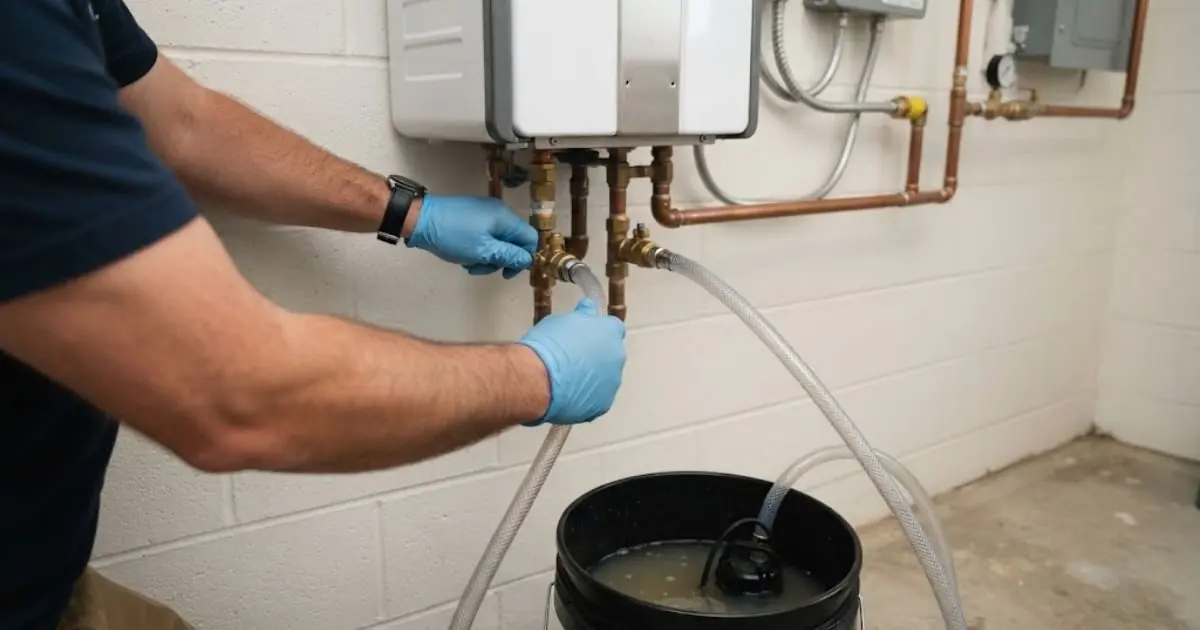
Hard water leaves mineral scale on the heat exchanger, which reduces flow and triggers errors. Descaling flushes the unit with a mild acid solution.
Where hardness is high, a water softener protects the unit. Ask about your own water before you assume it is a problem, and test your tap if you are not sure.
Call to book a visit. We bring a clear price before work starts.
Common tankless faults
- Error codes for ignition or flame failure.
- Lukewarm water after a short burst of hot.
- Reduced flow with several fixtures running.
- Condensate drain clogs on high-efficiency models.
- Venting blocked by snow or debris in winter.
Most are fixable on the first visit when the part is on the truck.
Installing a tankless unit
We size the unit to peak demand, upgrade the gas line if needed and run a code-compliant vent. We install isolation valves so descaling is easy.
You can read how this fits with other options at water heater installation. If you want hot water at the far end of the house, a recirculation line may be added.
Keeping a tankless unit healthy
Descale once a year or as the water demands. Clean the inlet filter, check the vent and keep the area around the unit clear.
A tankless unit can last many years with care, so a small yearly visit protects a large investment.
Sizing and flow rate in plain terms
A tankless unit is rated by how many gallons per minute it can heat by a set temperature rise. In winter, incoming water is colder, so the same unit delivers less hot water than in summer.
We add up the fixtures that run at the same time, such as a shower and a dishwasher, and size for that peak. An undersized unit is the main reason owners are disappointed.
Incoming water temperature and winter performance
Water from Lake Michigan systems arrives colder in winter, so a tankless unit works harder from December through March. Output at the tap may drop if the unit is sized close to the limit.
We size for the coldest month, not the average. That way a winter shower stays hot even when the dishwasher is running.
What affects the price of tankless service
Tankless work ranges from a quick descale to a full installation. We quote after we see the unit and the site.
- Service typeDescaling, repair and new installation are different jobs.
- Gas line and ventingUpgrades add parts and labor.
- Water qualityHard water may need a softener or more frequent service.
- Model and partsSome brands have costly parts.
Routine service is not covered by insurance. Sudden leaks that damage a home may be, so keep photos.
Standards we follow: Work follows the Illinois Plumbing Code (77 Ill. Adm. Code 890), and Illinois requires a plumbing license under 225 ILCS 320. Gas connections and venting also follow NFPA 54, the National Fuel Gas Code, and the manufacturer instructions.
Want your real number? Describe the problem when you call, and we will explain what the visit involves before any work starts.
Endless hot water, done properly
Licensed, insured plumbers, clear price before work starts.
Call (847) 281-8626