
Tankless Water Heater With a Storage Tank for Waukegan Homes
People search for a tankless heater with a storage tank when they want the efficiency of on-demand heating without the cold-water sandwich between uses. Several designs answer that need.
This guide compares them in plain terms. For installation, see our tankless water heater page.
What people mean by this phrase
A pure tankless unit has no storage. A hybrid unit combines a small internal tank with a burner, and a buffer tank sits next to a tankless heater to smooth out demand.
Both aim to fix short draws, where a tankless heater fires too late for a quick rinse. They also help recirculation systems.
Hybrid units
A hybrid unit keeps a small volume of hot water ready and tops it up with an efficient burner or a heat pump. It delivers hot water quickly and runs less often than a standard tank.
Hybrid units cost more than basic tanks. They need space, a drain for condensate and sometimes a power outlet and venting that differ from a traditional heater.
Call to talk through tank, tankless and hybrid options.
Buffer tanks beside a tankless heater
A small insulated tank placed after the tankless heater stores a few gallons. When you open a tap for a short draw, the buffer supplies hot water while the heater ramps up.
This setup helps with recirculation loops, where the tankless unit would otherwise cycle on and off. It adds pump, valves and an expansion tank, so it needs planning.
When a plain tank is the better choice
A standard tank costs less and takes simple repairs. If your household uses hot water in big bursts, and space is not limited, a tank can be a sound pick.
If you are weighing options, our water heater installation page explains how we size units for a home.
Gas, venting and electrical needs
Tankless and hybrid units use more gas at once than a tank. The gas line may need an upgrade, and the vent may be a different material and size.
Condensing units produce acidic condensate that must drain correctly. We plan these details before quoting.
Maintenance across all types
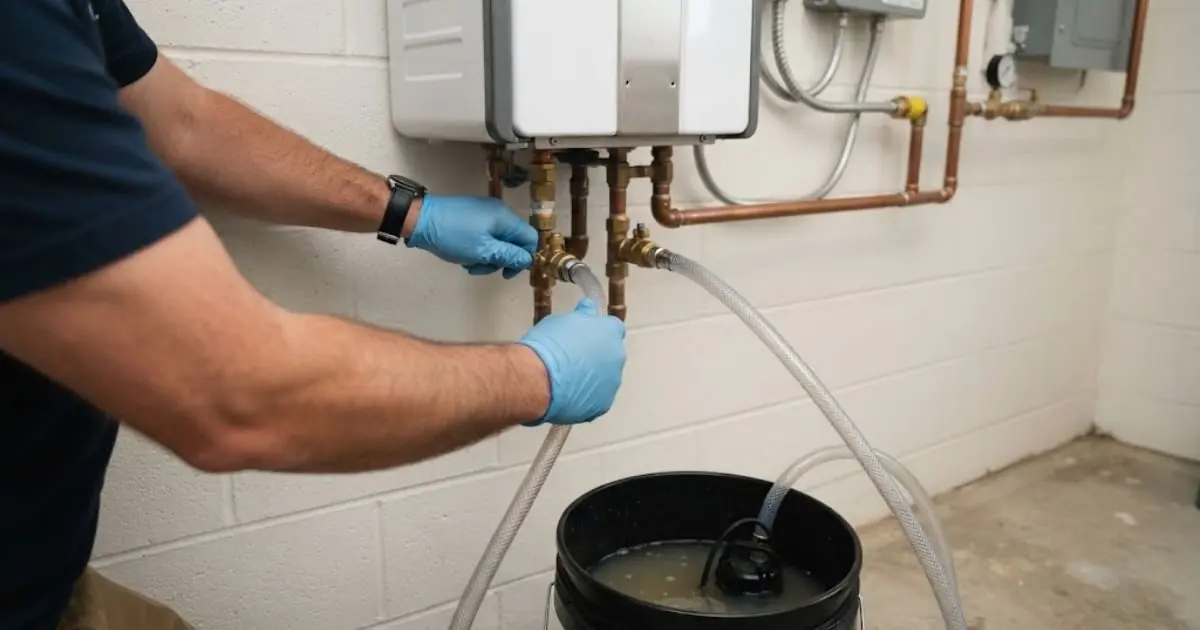
Flush a tankless unit for scale, clean the inlet filter and check the vent. A buffer or hybrid tank should be drained and inspected on a schedule.
Regular care keeps efficiency up and prevents repair calls. It also makes it easier to spot leaks early.
Recirculation loops and short draws
A recirculation loop keeps hot water moving so it reaches the far bathroom fast. A tankless unit that is asked to fire for tiny flows may short-cycle, which wears parts and wastes energy.
A buffer tank gives the unit a cushion, so it fires less often and for longer runs. If you plan a loop, tell the installer before the unit is chosen.
Space, noise and venting
A tankless unit hangs on a wall, but a buffer tank needs a few square feet of floor space. Condensing models also need a condensate drain and plastic vent pipe.
Check the clearances in the manual and plan access for service. A good layout today prevents an awkward repair later.
A fair way to decide
Write down who uses hot water, when and how much. Note the number of bathrooms, whether a soaking tub is used and whether you want a recirculation loop.
Bring that list to a plumber and ask for two options with the same scope. Compare the total cost over the years you expect to stay in the home, not only the first price.
Questions to ask before you choose
Ask the installer how the unit will be vented and where the condensate will drain. Ask what the gas line must carry and whether it must be upgraded.
Ask also about service access and parts. A unit that is easy to service saves money for years.
Energy use and the long view
On-demand heating avoids the heat that a tank loses while it sits. A buffer tank brings some of that loss back, although a well-insulated one is small.
The honest answer for most homes is that comfort and reliability matter as much as efficiency. Choose the setup that gives your household steady hot water with the least trouble over the years you plan to live there.
Common mistakes when choosing
- Buying by price without checking the gas line size.
- Skipping the water test and ignoring scale.
- Forgetting that a recirculation pump needs a plan.
- Choosing a unit that is too small for winter water temperature.
A short visit before the purchase prevents each of these.
Water quality in the Lake County supply
The Central Lake County Joint Action Water Agency, which supplies communities such as Gurnee and Libertyville from Lake Michigan, publishes a hardness of about 8 grains per gallon, or 137 mg/l as calcium carbonate. That is enough to leave scale on a heat exchanger over time.
If your home is in Gurnee or Libertyville, plan to descale a tankless or hybrid unit regularly, and consider a softener to protect it. Waukegan has its own plant and hardness, so test your own tap.
Tankless with storage questions
It can be if you want quick hot water and efficiency. It costs more and needs more setup, so we compare against a standard tank.
Only if you have short draws or a recirculation loop that causes cycling. Many homes do fine without one.
Often yes, with a pump and an expansion tank. We assess your setup first.
Hybrid and buffer tanks need floor space and clearances. We measure before recommending.
Choose the right heater
Licensed, insured plumbers, clear price before work starts.
Call (847) 281-8626