
Where to Install an Expansion Tank on a Tankless Water Heater in Waukegan, IL
Heated water expands. In a closed plumbing system, that expansion has nowhere to go, and pressure can spike. An expansion tank gives the extra volume somewhere to sit.
This guide explains when a tankless setup needs one and where it goes. For the install itself, see water heater installation.
Why expansion matters
When water heats from cold to hot, it takes up more space. In an open system, the extra water pushes back into the city main. In a closed system, with a check valve or a pressure reducing valve, it cannot.
The pressure rises until a relief valve opens, or until a fitting leaks. Repeated spikes wear out valves and the heater.
Does a tankless heater need one?
A tankless unit holds very little water, so thermal expansion is small. Even so, a closed system with a recirculation line or a whole-house storage can create spikes.
Some manufacturers require an expansion tank in closed systems. Read the manual, and ask your plumber to check your water pressure.
Call and we will check pressure and expansion.
Where the tank goes
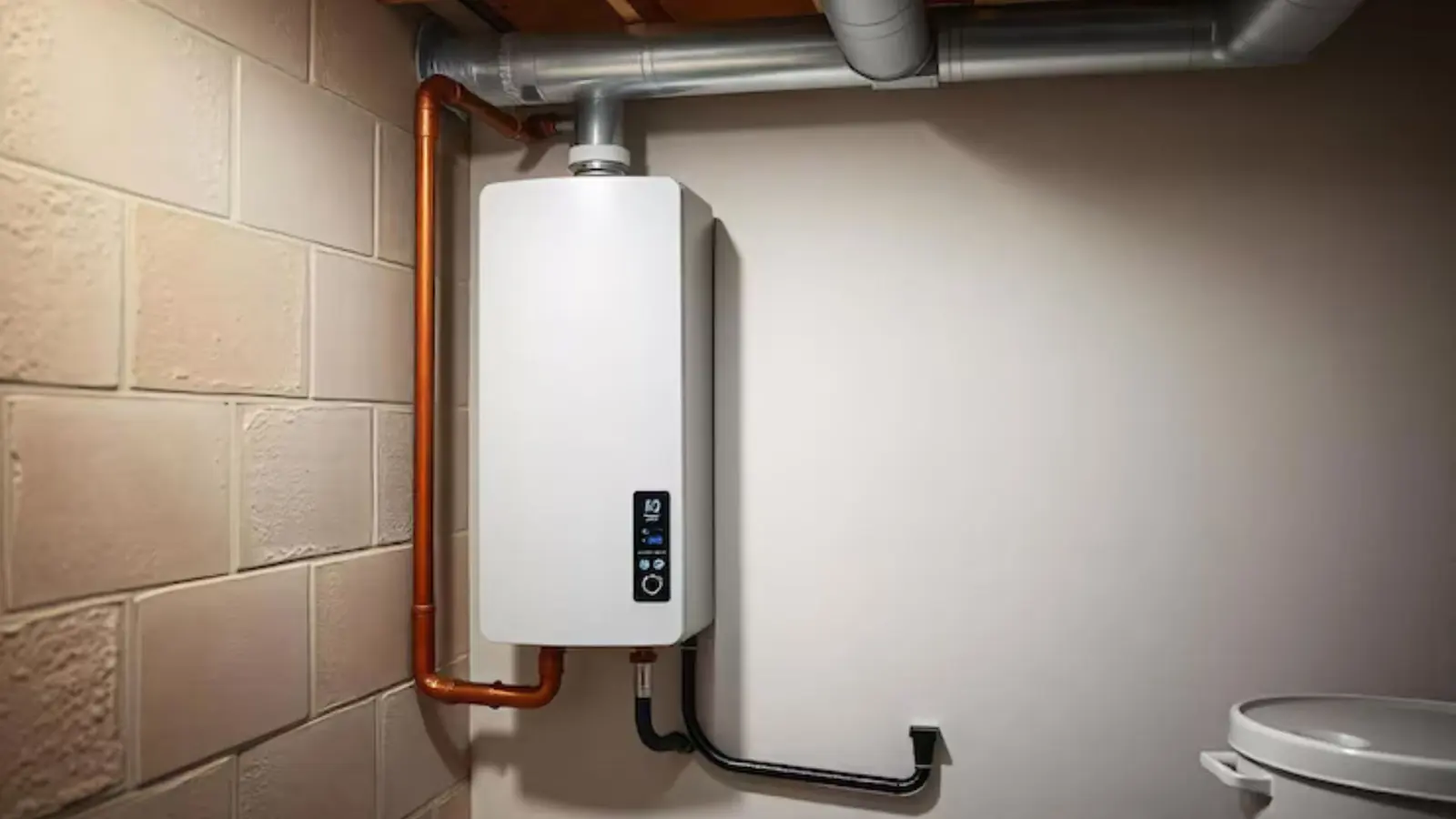
The tank connects to the cold supply line on the inlet side of the heater, between the shutoff valve and the heater. It should be supported, since a full tank is heavy.
- Install it on the cold line, not the hot.
- Mount it upright or as the manufacturer allows.
- Use a tee fitting and a support strap.
- Keep it accessible for service.
Sizing and air pressure
Expansion tanks come in sizes by volume. The tank must be precharged to match your house pressure, and a gauge confirms it.
A tank precharged to the wrong pressure will not work. We check this at every install.
Signs the tank is failing
A relief valve that drips, banging pipes and a tank that feels full of water when tapped all point to a failed bladder. A working tank sounds hollow at the top.
Replace the tank rather than trying to recharge a waterlogged one.
What to ask the installer
Ask whether the system is closed, what the water pressure is and whether the manufacturer requires a tank. A pressure test takes minutes and answers the question.
Licensed plumbers install the tank as part of the job, with proper permits where needed.
How to check your house pressure
A simple pressure gauge screws onto a hose bib and costs little. Read it with no water running, then run hot water and watch the needle rise as the heater fires.
House pressure should stay below about 80 pounds. A reading above that, or a needle that climbs well past the starting point, means you need an expansion tank or a pressure reducing valve.
Pressure reducing valves and thermal spikes
A pressure reducing valve near the main protects fixtures from high street pressure, and it also makes the system closed. That is why tanks and valves often go together.
If you have one, a thermal spike from the heater has nowhere to go. An expansion tank fixes that, and it also quiets knocking in the pipes.
Maintenance and what to watch for
Every year, check the air pressure at the tank valve with the water off and the tank drained. Add air with a pump if it has dropped.
If water comes out of the air valve when you press it, the bladder has failed. Replace the tank, and make a note of the date so you know when the next check is due.
A simple pressure test you can do today
Screw a pressure gauge onto an outdoor hose bib and open the valve. Record the pressure with the water off, then run hot water for a few minutes.
If the pressure rises sharply or exceeds the safe range, call a plumber. It is a quick test that avoids guesswork.
Signs of thermal expansion trouble
Dripping from the relief valve after the heater runs, banging pipes and a toilet that refills by itself can all trace back to pressure swings. A pressure gauge confirms it.
Fixing it early protects the heater, the valves and the fixtures. A small tank and a short visit cost far less than replacing a worn relief valve and a damaged fitting.
Tank sizing in plain terms
Expansion tanks are sized by the volume of water in the system and the house pressure. A small tank suits a small tankless setup, and a larger tank suits a system with a storage heater.
The label on the tank shows its acceptance volume. We match it to your system and verify the air charge before we leave.
Check your service with the village or the City
Whether a home is a closed system depends on the service connection and any backflow or check valve at the meter. The Illinois Plumbing Code, Title 77 Part 890, sets the state rules, and your village or city building office can tell you what applies at your address.
In Park City and Beach Park, as in Waukegan, ask whether a backflow device is on your line. A plumber with a pressure gauge can also tell you in minutes. Standards we follow: relief valves, discharge pipes and expansion control follow the Illinois Plumbing Code (77 Ill. Adm. Code 890) and the heater manufacturer instructions.
Expansion tank questions
If there is a check valve or a pressure reducing valve on the main, it is probably closed. A pressure gauge on a hose bib can show spikes after the heater fires.
A careful owner can in some cases under the Illinois exemption for an owner-occupied single-family home. We recommend a licensed plumber for gas and venting work.
Yes. A temperature and pressure relief valve with a proper discharge pipe is a safety requirement.
Many last years, and a waterlogged tank is easy to spot. Test it when you service the heater.